By Chad Meier, March 30, 2026
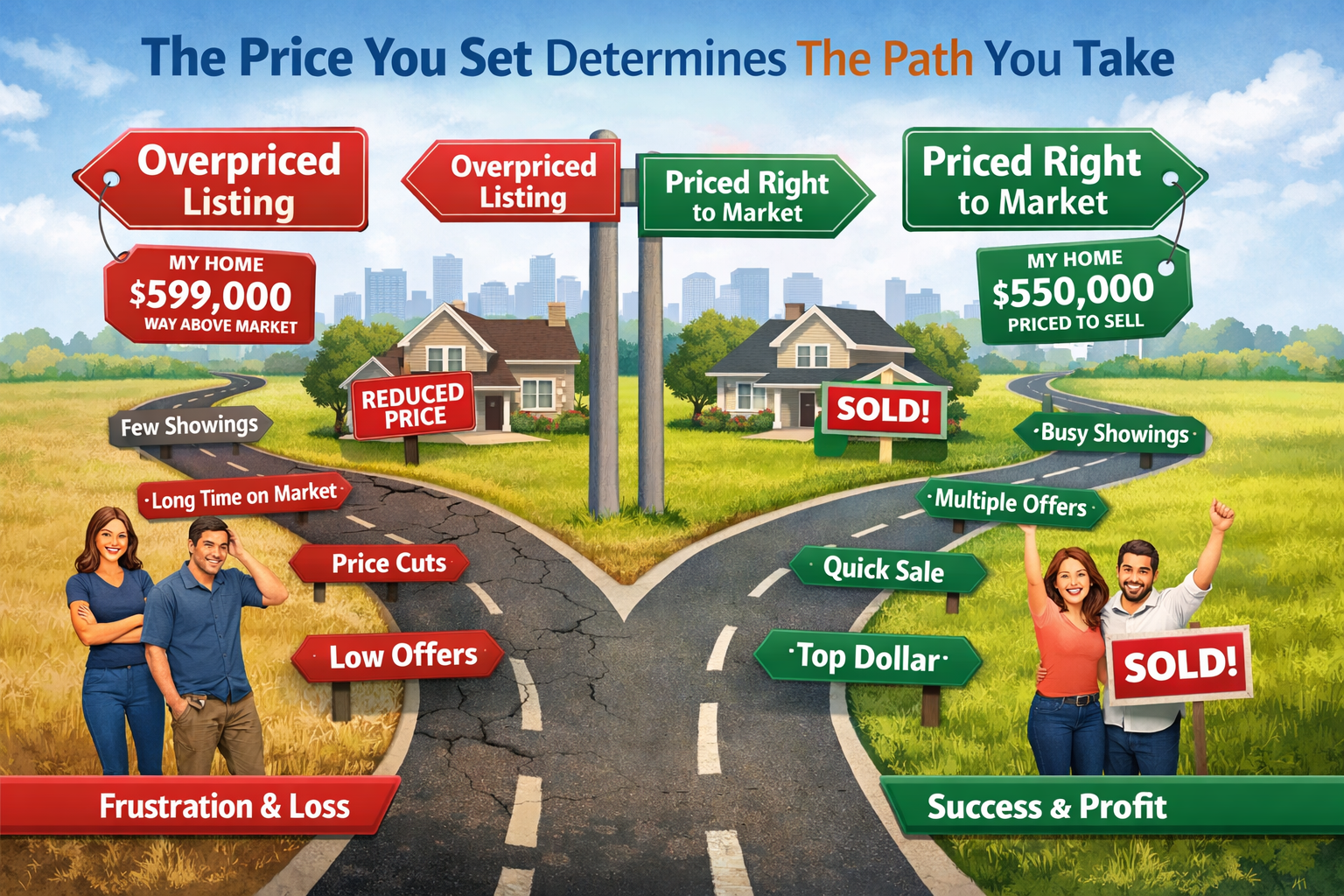
In real estate, few decisions carry more weight than the list price. It’s not just a number—it’s a strategy, a signal to the market, and often the difference between a smooth, rewarding sale and a long, frustrating ordeal. Yet every market cycle brings the same divide: sellers who insist on pricing aspirationally, and those who trust the data-driven guidance of their real estate agent. The contrast in outcomes between these two paths is stark—and remarkably consistent.
The Temptation of “Testing the Market”
For many sellers, the logic feels sound: “We can always come down later.” Whether fueled by emotional attachment, optimistic online estimates, or stories of record-breaking sales, the idea of starting high can feel like a low-risk move.
In reality, it rarely is.
Homes that hit the market overpriced tend to experience:
- Fewer showings from the start
Buyers today are highly informed. They track price trends, compare listings instantly, and often skip over homes that appear out of sync with the market. - Longer days on market
The longer a property sits, the more it raises questions. Buyers begin to wonder: What’s wrong with it? - Price reductions that weaken negotiating power
Each reduction can signal urgency—or worse, desperation—leading to lower offers than if the home had been priced correctly from day one. - A final sale price below market value
Ironically, overpricing often results in netting less, not more.
Overpriced listings don’t just miss the mark—they miss the moment.
The Power of Pricing with Precision
On the other side are sellers who align with current market data and professional guidance. They price strategically, not emotionally.
These homes tend to benefit from:
- Strong initial activity
When a home is priced correctly, it attracts immediate attention. Showings cluster in the first days and weeks—when interest is at its peak. - Competitive dynamics
Well-priced homes can generate multiple offers, which can drive the final price up—not down. - Shorter time on market
Momentum matters. Homes that sell quickly often sell closer to (or above) asking price. - Cleaner, more confident negotiations
When pricing is validated by the market, sellers are in a stronger position to evaluate and accept favorable terms.
In many cases, the best offers come not from stretching the price ceiling—but from aligning perfectly with where the market already is.
The First Two Weeks: Your One Shot at Peak Exposure
Every listing has a window of maximum visibility. It’s when new buyers see it, agents share it, and interest is naturally highest.
If a home is overpriced during this critical period, the opportunity isn’t just delayed—it’s diminished. By the time the price is corrected, the listing is no longer “new,” and the pool of eager buyers has already moved on.
Pricing right from the start isn’t conservative—it’s strategic.
Emotional Value vs. Market Value
One of the hardest parts of selling a home is separating what it means to you from what it’s worth to the market.
Sellers who struggle most are often trying to capture intangible value—memories, upgrades they loved, or the uniqueness of their property. While those things matter personally, buyers evaluate homes through a different lens: comparable sales, condition, and alternatives.
Agents don’t price homes to limit sellers—they price them to position sellers for success.
The Bottom Line
There are two very different selling experiences:
- One is reactive—chasing the market, adjusting downward, and negotiating from a position of weakness.
- The other is proactive—meeting the market where it is, generating demand, and negotiating from strength.
Both begin with a single decision: where to price the home.
The data is clear, and the pattern repeats itself in every neighborhood, every year. Sellers who trust the market—and the professionals who interpret it—consistently come out ahead.
Not just in price, but in time, stress, and overall experience.
If you’re thinking about selling, the question isn’t “What do I want to list it for?”
It’s “Where will the market respond?”
Because in real estate, the right price doesn’t just attract buyers—it creates opportunity.


Chad Meier
Broker | OR
He/Him
Hello, I’m Chad: Licensed Real Estate Broker, native Oregonian, photography aficionado, lover of old houses, friend to all animals, and powered by analytical data.
As a member of the National, Oregon and Portland Metropolitan Associations of REALTORS®, I'm proud that my profession allows me to use the tools I've acquired over the past 20+ years (client advocacy, sales & marketing, conflict resolution, et al.) to help people on a daily basis. Bottom line… I love the work!
Through personal experience, I understand that buying or selling a home is more than just a business transaction; In fact, it can often be a life changing event! This is why I’m dedicated to providing exceptional service for my clients when it’s time for them to make their move.
On the listing side; I believe that every home, no matter how modest or grand, deserves to make the best possible first impression on a would-be buyer. This is why I’m aligned with our area's preeminent independent real estate brokerage (Living Room Realty) to offer every property the most compelling & relevant marketing available. It also means that I’ll never represent your home online with a smartphone picture ;^)
On the buying side; I personally work with every client - no handing you off to a junior team member of a team - to ensure that we work toward your goals together and don’t fall prey to some of the pitfalls that buyers can face in today's heavily weighted market. In short, I can help you win!
Above all else, I pledge to be a strong advocate for my client’s interests and promise to work relentlessly to help them achieve their real estate goals. After all, I believe that if you’re not left with an amazing experience, I haven’t done my job.
Speaking personally, I’ve been connected to this great city and its surrounding areas since childhood. Most recently, my family (wife Shawn, son Jakob, mother Glenna, and mutts Juno & Dizzy) have lived in the vibrant Sellwood-Moreland neighborhood for the past 14 years. When not at my desk or in the field helping clients, you’ll likely find me trying to capture a compelling scene behind my camera lens, playing basketball wherever I can find a pickup game, or combining these two passions by photographing my son’s high school basketball team in action (GO WARRIORS!). And on occasion, you may even find me at any number of our city's finer dining establishments, searching high and low for a bartender who knows the recipe for a perfect Roman Holiday ;^)
Whether you have a plan to buy or sell (or simply need to develop one), please feel free to contact me. I look forward to understanding your goals and helping you achieve them!
I can be reached at 503-709-9600 -or- Chad@PortlandHomeBase.com
Read More